
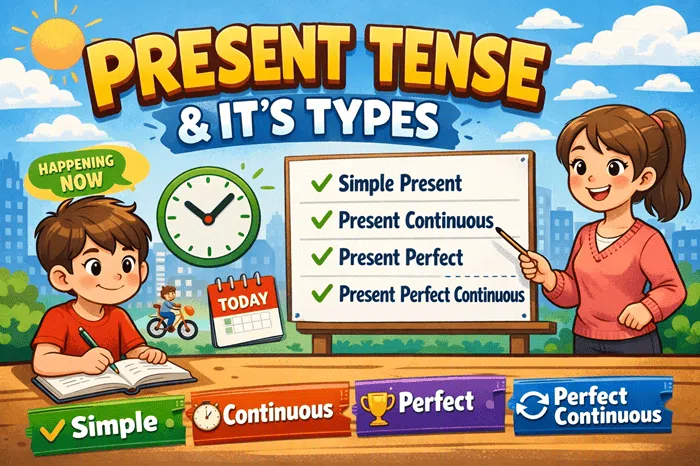
The present tense indicates actions happening now, routines, or general truths, divided into four forms: simple (I work), continuous (I am working), perfect (I have worked), and perfect continuous (I have been working). It primarily uses the base verb form, adding ‘-s’ for third-person singular subjects.
Present Indefinite Tense
The present indefinite tense, also known as simple present tense, denotes a stative, habitual, or eternally true action. Simple Present is a form of the verb that shows the action takes place in the present.
Generally, simple present tense is used to indicate an action which happens – always, regularly, every day, daily, normally, generally, usually, occasionally, sometimes, often, rarely, frequently, nowadays, naturally, seldom, constantly, never, every week, every year, once a year, on a week, at times, at present, now and then, or all the time.
Here are the different usages of this tense:
- Repeating actions or habits
- She drinks coffee every morning.
- He does not play football on weekends.
- Do they visit their grandparents often?
- Facts or things that are true at all times
- The sun rises in the east.
- Water does not burn.
- Is gold a metal?
- Conditions (not actions) are taking place at this moment
- He is my best friend.
- She does not have a pet.
- Do they own a car?
| Verb Type | Affirmative | Negative | Interrogative |
| Be Verb | I + am Ex: I am a teacher. |
I + am not Ex: I am not a lazy person. |
Am + I Ex: Am I your neighbor? |
| He/She/It + is Ex: He is a talented artist. |
He/She/It + is not Ex: He is not my cousin. |
Is + He/She/It Ex: Is he a football player? |
|
| We/You/They + are Ex: They are my classmates. |
We/You/They + are not Ex: They are not at home. |
Are + We/You/They Ex: Are you your classmates? |
|
| Have Verb | I/You/We/They + have Ex: We have a new car. |
I/You/We/They + do not have Ex: We do not have a television. |
Do + I/You/We/They + have Ex: Do we have enough chairs? |
| He/She/It + has Ex: She has a gold necklace. |
He/She/It + does not have Ex: She does not have a bicycle. |
Dose + He/She/It + have Ex: Does she have a pen? |
|
| Action Verb | I/You/We/They + V1 Ex: I read books every night. |
I/You/We/They + do not + V1 Ex: I read books every night. |
Do + I/You/We/They + V1 Ex: Do you read newspapers daily? |
| He/She/It + V+(s) Ex: He enjoys playing chess. |
He/She/It + does not + V1 Ex: He does not like pizza. |
Does + He/She/It + V1 Ex: Does he watch TV at night? |
Present Progressive (Continuous) Tense
The Present Progressive is a form of the verb that shows the action is in progress in the present. However, the stative verbs do not usually take the form of present progressive tense even though they refer to the present time.
Now, those days, this afternoon, today, tonight, constantly, continually, currently, perpetually, at this moment, at the moment, right now, this season, this year, forever, etc., words or word pairs are usually signs that the verb in a sentence is in the present progressive form. However, these signs are not necessary all the time for a verb to be of present progressive tense.
Here are the different usages of this tense:
- Actions that are happening now
- The baby is sleeping.
- The TV is not working.
- Is she talking on the phone?
- Actions that are currently in progress (Not at this exact moment, but in the present)
- He is learning Spanish this year.
- She is not living in New York anymore.
- Are they building a new house?
- Planned future actions
- We are visiting our grandparents next weekend.
- She is not attending the meeting tomorrow.
- Are they going to watch the new movie tonight?
| Affirmative | Negative | Interrogative |
| I + am + Ving Ex: I am reading a book. |
I + am not + Ving Ex: I am not watching TV. |
Am + I + Ving Ex: Am I disturbing you? |
| He/She/It + is + Ving Ex: She is cooking dinner. |
He/She/It + is not + Ving Ex: He is not studying now. |
Is + He/She/It + Ving Ex: Is she talking to her friend? |
| We/You/They + are + Ving Ex: They are playing football. |
We/You/They + are not + Ving Ex: We are not singing a song. |
Are + We/You/They + Ving Ex: Are they playing outside? |
Present Perfect Tense
The Present Perfect is a form of the verb that shows the action was completed before the present. It means the action is finished.
Generally, the present perfect tense is used to indicate an action which happens – before the present, recently, up to now, even, recently, since, never, lately, for, once, already, from, 3 times, just, till now, so far, yet, till date.
Here are the different usages of this tense:
- Actions that happened at an unspecified time before the present
- She has visited Paris twice.
- He has never been to Japan.
- Have they completed the project?
- Actions that ended recently
- He has just finished his homework.
- She has not washed the dishes yet.
- Have you heard the latest news?
- States that started in the past and are still going on
- She has been a teacher for ten years.
- He has not had a holiday in months.
- Has she owned this house since 2010?
| Affirmative | Negative | Interrogative |
| He/She/It + has + V3 Ex: She has cooked dinner. |
He/She/It + has not + V3 Ex: He has not studied yet. |
Has + He/She/It + V3 Ex: Has she talked to her friend? |
| I/We/You/They + have + V3 Ex: They have played football. |
I/We/You/They + have not + V3 Ex: We have not sung a song. |
Have + I/We/You/They + V3 Ex: Have they played outside? |
Present Perfect Progressive (Continuous)
The Present Perfect Progressive is a form of the verb that shows the action started in the past and continued up until the present.
It is the least used form of the present tense. Present perfect progressive tense is used to indicate an action that began in the past and is still occurring in the present. Both the present perfect and the present perfect continuous tense can be used to indicate this type of action.
- An action that started in the past and continued up until the present
- She has been reading for the last two hours.
- It has not been raining for three months.
- Have they been waiting since morning?
- Typical Time Expressions: Up to now, Recently, For, lately, Since, recently, all morning
| Affirmative | Negative | Interrogative |
| He/She/It + has been + Ving Ex: She has been reading a book for two hours. |
He/She/It + has not been + Ving Ex: He has not been studying for a long time. |
Has + He/She/It + been + Ving Ex: Has she been talking to her friend since morning? |
| I/We/You/They + have been + Ving Ex: They have been playing football since morning. |
I/We/You/They + have not been + Ving Ex: We have not been singing for an hour. |
Have + I/We/You/They + been + Ving Ex: Have they been playing outside for an hour? |
Common Mistakes with Verb + -ing Form
When adding -ing to verbs, there are specific rules to follow. Here are two important ones:
- Dropping the silent -e and adding -ing: For verbs ending in a silent -e, replace the -ie with -y before adding -ing. Example:
- Lie lying (correct)
- Lie lieing (incorrect)
- Adding -ing directly (no changes): For most verbs, simply add -ing without any changes. Example:
- Buy buying (correct)
- Play → playing (correct)



Leave a Comment