
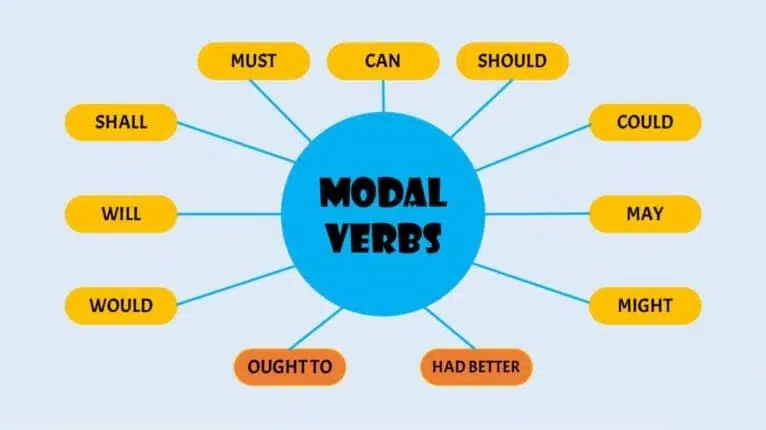
What are modal verbs?
English modal verbs are special verbs that are used to show possibility, ability, permission, and so forth. Examples:
- It might rain – shows possibility.
- I can juggle – shows ability.
- You may sit down – shows permission
The modal verbs are: Can, Could, May, Might, Must, Shall, Should, Ought to, Will, Would. They are Auxiliary verbs that provide additional and specific meaning to the main verb of the sentence
What does MODAL mean?
Modal = expressing mood.
Mood = a way to express the attitude of the speaker to what is being said.
Examples:
- I can paint means the speaker believes he has the ability to paint.
- I might paint means the speaker believes there is a possibility for that to happen.
- I will paint means the speaker has the intention to paint.
English Modal Verbs show us the attitude of the speaker to what is being said.
How do we use modals?
Subject + Modal auxiliary verb + Main Verb. For examples I + Can + Speak.
They do not accept conjugation. They do not need other auxiliary verbs.
e
1. Modals are special because they behave differently from other verbs in English: English modal verbs are used together with the base form of another verb. Examples:
- He might come late.
- You may leave if you wish.
- We must finish this on time.
2. English modal verbs have only one form. You don’t add “-ing”, “-ed” or “-s” to them. Examples:
- Correct: We must go now.
Incorrect: We are musting go now. - Correct: They said we could park here.
Incorrect: They said we coulded park here. - Correct: She can help us.
Incorrect: She cans help us.
3. To form questions, use the modal verb itself but change the order. Examples:
- He can fix the car tomorrow.
Correct: Can he fix the car tomorrow?
Incorrect: Does he can fix the car tomorrow? - We should start packing our things.
Correct: Should we start packing our things?
Incorrect: Do we should start packing our things? - She will be ten years old next month.
Correct: Will she be ten years old next month?
Incorrect: Does she will be ten years old next month?
4. There is no “s”, do/does, do not/ does not in modals.
- There is no “s” in singular,
Correct: He can write.
Incorrect: He cans write.
Incorrect: He can writes. - There is no “do/does” in the question.
Correct: Would you like to come with me?
Incorrect: Do you would like to come with me? - There is no “do not / does not” in the negative.
Correct: They cannot be serious.
Incorrect: They do not can be serious
Correct: She cannot drive
Incorrect: She does not can drive
5. Modal verbs do not have infinitives or -ing forms. Example:
- Correct: to can
Incorrect: I caning - Correct: to must
Incorrect: I musting
6. Modal verbs are followed by an infinitive without to.
- She must study (strong obligation)
- We should have gone the other way (recommendation)
- He could play football in his youth (ability in the past)
7. Modal verbs do not have all the tenses. They use other verbs to complete the tenses.
- Can is completed with be able to
They can play the piano. ——-They will be able to play the piano in the future. - Mustis completed with have to
You must come early. ——-You had to come early yesterday. - Modals can have more than one meaning depending on the situation.
1. Single Concept Modal: they have one meaning
2. Double Concept Modal: they have two meanings
3. Modals in past: They are used to express a situation in the past
CONCEPT MODALS
1. SINGLE CONCEPT MODALS: Sub + modal+ v1+ ext.
| Modal | Concept | Examples |
| Will | Future | Jubaer will travel to Noakhali next week. |
| Might | Small probability | I might move to Canada some day. |
| Should | Recommendation | You should go to the doctor. |
| Ought to | Formal recommendation | We ought to know about first aids. |
| Had better | Warning | I had better study, or I will fail the test. |
| Need to | Necessity | You need to submit your assignment on time. |
| Need not | Lack of necessity | You need not worry about the results. |
2. DOUBLE CONCEPT MODALS: Sub + modal+ v1+ ext.
| Modal | Concept | Examples |
| May (1) | Permission | May I come in? |
| May (2) | Good probability | We may visit Barishal this summer. |
| Must (1) | Responsibility | Everyone must pay taxes. |
| Must (2) | Assumption | She did not arrive. She must be sick. |
| Would (1) | Past (used to) | When I was young, I would play soccer. |
| Would (2) | Present unreal | I would buy the car, but I cannot afford it. |
| Shall (1) | Offer | Excuse me, I shall go now. Shall I clean it? |
| Shall (2) | Contractual obligation | The company shall pay on January 1st. |
| Could (1) | Unreal Ability | I could go if I had time. |
| Could (2) | Past Ability | She could play the piano. (but she cannot anymore) |
| Can (1) | Present Ability | We can speak English. |
| Can (2) | Permission | Can I have a candy? |
| Could | Probability | You could visit the museum. |
| Would | Offer | Would you like a cup of coffee? |
3. MODALS IN THE PAST
They are modals referring to actions that happened in the past. They are also referred to as modal perfect. Example: They should have invited her.
Structure: MODAL + HAVE +verb in past participle
| MODAL PERFECT | USES | EXAMPLES |
| MUST HAVE + P.P | Logical conclusion on a past event | Peter has arrived late. He must have been in a traffic jam. |
| MUST NOT HAVE + P.P. | Logical certainty that something did not happen | He must not have seen you. |
| MAY/MIGHT HAVE + P.P. | Deduction on a past event | Joe may / might have taken the wrong train. |
| MAY NOT/MIGHT NOT HAVE + P.P | Uncertainty about something not happening | He might not have received your message yet. |
| COULD HAVE + P.P. | Possibility to do something, gone unfulfilled | You could have played better. |
| COULD NOT HAVE + P.P. | Certainty that something could not have happened | He could not have passed because he had not studied enough. |
| WOULD HAVE + P.P | Desire to do something, but impossibility to do it for external causes | I would have visited you, but I forgot your address. |
| WOULD NOT HAVE + P.P. | Certainty that something would not have happened | I would not have left if I had known you were coming. |
| SHOULD/OUGHT TO HAVE + P.P. | Lament on something that should have been done | You should / ought to have warned me earlier |
| SHOULD NOT HAVE + P.P | Critique on something that shouldn’t have happened | He should not have told them. |
| OUGHT NOT TO HAVE + P.P | Expressing regret or criticism | You ought not have spoken to her like that. |
| NEED NOT HAVE + P.P. | Something that was not necessary to do | You need not have bought it. |
Common Mistakes
| May | Can |
| Express possibility Ex: The guest may come today. |
Denote ability. Ex: He can count to 100. |
| Ask for or give permission Ex: You may go to your room. Or, may I leave the table? |
Ask for permission Ex: Can I ask you some questions? |
| Express a wish or hope Ex: May you have a long and healthy life |
Request someone to do something Ex: You can borrow my pen. |
| May is used in formal contexts. | Can is used in informal contexts. |


Leave a Comment