
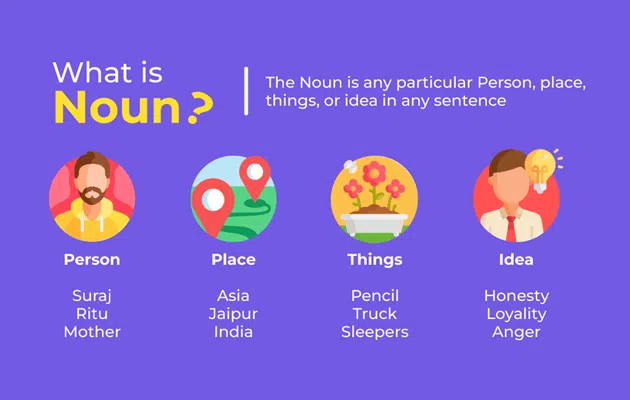
Hello! When you think of learning English grammar, which topic comes to mind first? Surely Noun? That’s right! Noun is the very foundation of the English language.
What is Noun
A noun is the part of speech that names a person, place, animal, thing, or idea. In simple words, Noun means a Naming Word. Everything you see around you, everything you feel—the name of everything is a Noun. In sentences, nouns generally function as subjects or as objects.
But not all nouns are the same. One is the name of a person (Rahim), and the other is the name of a quality (Honesty). To understand these differences properly, we need to know the types of Nouns. Today, we will learn the A-Z of Nouns with many examples.
The easiest way to recognize Nouns (2 main parts)
We can mainly divide any Noun into 2 parts. Once we understand this part, the rest will become easy.
- Concrete Noun: Nouns that have a real or physical existence and that we can experience with our five senses are called Concrete Nouns. That is, those that can be seen, touched, heard, smelled, or tasted. Example: Book (book – seen, touched), Water (water – touched, tasted), Music (music – heard), Flower (flower – smelled).
- Abstract Noun (adjective noun): Nouns that have no real or physical shape. They cannot be held or touched; they can only be felt or understood in thought.
Example: Honesty (honesty), Love (love), Pain (pain), Childhood (childhood). We can feel them, but we cannot see them.
5 Traditional Types of Nouns
In school and college grammar, we mainly study these 5 types. Interestingly, the first 4 of these 5 are actually part of Concrete Nouns!
1. Proper Noun (নামবাচক বিশেষ্য)
A noun that is used to name a specific person, place, animal, or thing is called a proper noun. Proper nouns always begin with a capital letter. Example:
- Rahim is a good boy. (Here, Rahim is the name of a specific person)
- Dhaka is a big city. (Dhaka is the name of a specific city)
- The Padma is a big river. (Padma is the name of a specific river)
2. Common Noun (জাতিবাচক বিশেষ্য)
A noun that refers to a general person, place, animal, or thing rather than a specific name is called a common noun. Unlike proper nouns, common nouns are not capitalized unless they appear at the beginning of a sentence. Example:
- Man is mortal. (Here, Man is not referring to a specific person, but to the entire human race)
- He is a student. (Student refers to all students)
- A dog is a faithful animal. (All dogs in the world are being referred to)
3. Collective Noun (সমষ্টিবাচক বিশেষ্য)
A noun that refers to groups of people, animals, or things is called a collective noun. (crowd, mob, team, flock, herd, army, fleet, jury, nation, parliament, committee, etc.). Example:
- Our team won the match. (Team means a group of players)
- The army is marching. (Army means a group of soldiers)
- I have a bunch of keys. (Bunch means a bunch of keys)
4. Material Noun (বস্তুবাচক বিশেষ্য)
Things that cannot be counted, but can only be weighed or measured, are called Material Nouns. These are usually any substance or ingredient. Examples:
- Water has no color. (Water cannot be counted; it can be measured)
- Gold is precious.
- Give me some milk.
5. Abstract Noun (গুণবাচক বিশেষ্য)
A noun that refers to a concept, idea, feeling, or process that can not be physically perceived through the human senses is called an abstract noun. Basically, nouns that refer to the quality, state, or action of a person or thing. They cannot be caught or touched; they can only be felt. Examples:
- Honesty is the best policy. (Honesty – can’t be seen, it has to be felt)
- Kindness represents good character.
- Childhood is sweet. (Childhood – a state)
The entire chart at a glance (Revision Table)
| Types | Main idea | Example |
| Proper Noun | Proper noun | Bangladesh, Rahim, Titanic |
| Common Noun | Common noun/class | Country, Boy, Ship |
| Collective Noun | Group or Team | Team, Crowd, Navy |
| Material Noun | Object or substance | Gold, Water, Cotton |
| Abstract Noun | Quality or concept | Honesty, Love, Freedom |
Countable vs. Uncountable
Another important part of understanding a noun is whether it can be counted.
Countable Noun: A noun that can be counted in numbers is called a countable noun. For example, there are 5 apples in the box.
- They can be preceded by an indefinite article (a/an) – a book, an orange.
- Count nouns have plural forms – watches, men.
- Count nouns can have both singular and plural verbs.
Uncountable Noun: A noun that can not be counted in numbers is called an uncountable noun. For example, there is not enough water in the jar.
- They can never be preceded by an indefinite article (a/an).
- Non-count nouns do not have plural forms.
- Non-count nouns always take singular verbs in a sentence.
| Types | Description | Example |
| Countable Noun | Nouns that can be counted (e.g., 1, 2). | Pen, Book, Apple, Star, Boy |
| Uncountable Noun | Nouns that cannot be counted (have to be measured). | Water, Oil, Rice, Hair, Advice |
Tips: Material Nouns and Abstract Nouns are usually Uncountable.
Exceptions: Some nouns can be both count and non-count, but they will behave like either one according to the context they are in.
- He bought a cake for me. (here ‘cake’ is count)
- A lot of cake was eaten by us. (here, ‘cake’ is non-count)
- There is some juice on the table. (juice = drink/liquid)
- There are some juices on the table. (juices = different types of juices)
Commonly used non-count nouns list:
| Research | Snow | Furniture | Rice | Information | Rain |
| Luggage | Bread | Mathmatics | Steam | News | Corn |
| Advice | Electricity | Feedback | Coffee | Homework | Money |
Singular Noun and Plural Noun
Singular Noun: A noun that refers to only one person, place, animal, or thing is called a Singular Noun. For example, I have one book.
Plural Noun: A noun that refers to more than one person, place, animal, or thing is called a Plural Noun. For example, I have five books.
Rules for Making Plurals
Most nouns have to follow certain rules to be converted from singular to plural.
Rule 1: Add ‘s’ to the end of the noun (Most Common Rule)
Most nouns can be made plural by simply adding ‘-s’ to the end.
- Cat → Cats
- Dog → Dogs
- Apple → Apples
- Table → Tables
- House → Houses
Rule 2: Add ‘es’ to the end of the noun
If the last letter of the noun is s, ss, sh, ch, x, or z, then add ‘-es‘ to the end to make it plural.
- Bus → Buses
- Glass → Glasses
- Brush → Brushes
- Match → Matches
- Box → Boxes
Rule 3: If the Noun has ‘y’ at the end
If the last letter of the noun is ‘-y‘, then you need to look at the letter before it:
- If there is a Vowel (vowels: a, e, i, o, u) before ‘y‘: Only ‘-s‘ will be added.
- Boy → Boys
- Day → Days
- Key → Keys
- If there is a consonant before ‘y‘: remove the ‘y‘ and add ‘-ies‘.
- Baby → Babies
- City → Cities
- Story → Stories
Rule 4: Noun ends in ‘o’
If the last letter of the Noun is ‘-o‘, then look at the letter before it:
- If there is a vowel before ‘o’: just add ‘-s’.
- Radio → Radios
- Bamboo → Bamboos
- If there is a consonant before ‘o’: usually add ‘-es’.
- Hero → Heroes
- Potato → Potatoes
- Mango → Mangoes
- Echo → Echoes
Exceptions: Some nouns only add ‘-s‘:
- Photo → Photos
- Pian → Pianos
- Kilo → Kilos
Rule 5: If the noun ends in ‘f’ or ‘fe’
If the noun ends in ‘-f‘ or ‘-fe‘, remove the ‘f‘ or ‘fe‘ and add ‘-ves‘.
- Wife → Wives
- Knife → Knives
- Leaf → Leaves
- Life → Lives
- Thief → Thieves
Exceptions: Some nouns only add ‘-s‘:
-
- Chief → Chiefs
- Proof → Proofs
- Roof → Roofs
Irregular Plural Nouns
Some nouns do not follow any of the above rules. When changing them from Singular to Plural, the word changes inside the word, or the word remains the same. These need to be memorized.
1. Change within the word (Vowel Change)
- Man → Men
- Woman → Women
- Foot → Feet
- Tooth → Teeth
- Goose → Geese
- Mouse → Mice
2. Add ‘en’ or ‘ren’ at the end
- Ox → Oxen
- Child → Children
3. Singular and Plural are the same (No Change)
Singular and Plural are the same (No Change)
- Sheep → Sheep
- Deer → Deer
- Fish → Fish (but Fishes can be used to refer to different species of fish)
- Series → Series
Common Mistakes (Much/Many/Lots/A Lot)
We use different words depending on whether the noun is count or non-count.
- Much = Non-count nouns
- Many = Count Nouns
- A Lot/Lot of = Both
There is one other point to remember here. We mostly use Much/Many in a question or in a negative answer. For a positive answer, we use lots/ a lot.
- Is there much snow on the mountain? Yes, there is a lot of snow.
- Are there many peopleon the mountain? No, there are not many people.
Nouns are not difficult at all! If we try to remember its parts with examples, then we can easily find the Noun in any sentence. I hope this blog post has helped you get a clear idea of what a noun is. Keep practicing, grammar will become as easy as water!




Leave a Comment