This tutorial focuses on two built-in functions print() and input() to perform the Input Output and Import task in Python. Also, you will learn to use them in your program. Python provides numerous built-in functions that are readily available to […]
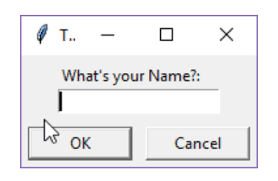
In this tutorial, we will create a user input dialog with python and prints it in the terminal, the purpose of this tutorial is to understand how to take the user input for the GUI application. Tkinter Module The Tkinter module (“Tk […]
In programming, a callable is something that can be called. In this post, we want to discuss Python callable() Explained. In Python, a callable is anything that can be called, using parentheses and maybe with some arguments. Functions, Generators, and […]
In this article, we discuss how to open and read text File in Python. There is a file attached with your assignment named mailbox-short.txt. Write a program to prompt for a file name, and then read through the file and […]
In this article, we will create a Python program to check prime number. Before we get started, if you want to Data Type in Python, please go through the following article: Data Types in Python. A prime number is a positive […]
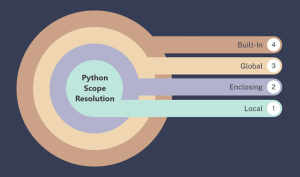
The LEGB rule in Python is a scoping rule used to determine the order in which namespaces are looked up when a variable name is referenced. In programming, the scope of a name defines the area of a program in which you can unambiguously access […]
In this article, you will learn how to create classes and objects in Python. Object-oriented programming (OOP) allows programmers to create objects that have attributes and methods, making the code more reusable and organized on a larger scale. Code utilizing classes […]
In this article, we will walk you through defining and using Python Functions. Before we get started, if you want to learn about Conditional Statements in Python, please go through the following article: Conditional Statements in Python. A function is a block of […]
In this tutorial of Python Functions, we’ve got talked about Built-In Functions in Python. Now we have 67 of these in Python 3.6 with their Python Syntax and examples. So, let’s begin with Python Built-In Functions. 1. abs() The abs() […]
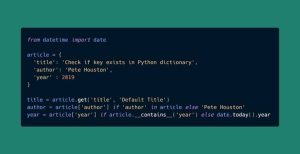
A Python dictionary is a data structure that stores values in key-value pairs. It is one of the most versatile and widely used data structures in Python. Dictionaries are unordered (as of Python 3.6+, they maintain insertion order), mutable, and indexed by […]