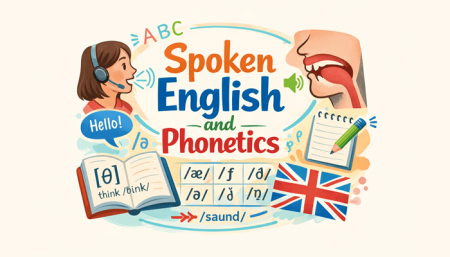
Think of Spoken and Phonetics as the difference between having a high-end sports car and actually knowing how to drive it. You might know all the vocabulary (the engine) and grammar (the mechanics), but “spoken and phonetics” is the skill that makes you move smoothly and sound like a local.
What is Spoken and Phonetics?
Spoken Language: This refers to the verbal communication of ideas. It’s not just about what you say, but your fluency, your choice of words in real-time conversation, and your ability to respond naturally.
Phonetics: This is the scientific study of speech sounds. It deals with how we physically produce sounds using our mouth, tongue, and throat.
- Articulatory Phonetics: How you move your “speech tools” (lips, teeth, tongue).
- Acoustic Phonetics: How sound waves travel to the listener’s ear.
Why is it Important?
- Clarity & Confidence: Even if your grammar is perfect, poor pronunciation can lead to misunderstandings. Good phonetics ensures you are heard the first time.
- Social Integration: People naturally gravitate toward those they can understand easily. It reduces the “mental effort” for the listener.
- Professional Edge: In global business, a clear, neutral, or well-articulated accent is often associated with competence and authority.
- Listening Skills: When you learn how sounds are made, you become much better at hearing them. You’ll understand fast-talking native speakers way more easily.
Zero to Hero: Your Action Plan
Becoming a “hero” in this field isn’t about memorizing a dictionary; it’s about muscle memory.
- Master the IPA (International Phonetic Alphabet)
Standard spelling is a liar (think of how “tough,” “though,” and “through” all sound different). The IPA provides one symbol for every sound. Learning it is like getting the “source code” for English. - The “Shadowing” Technique
This is the fastest way to improve.
– Find a clip of a speaker you admire (30 seconds).
– Listen once.
– Play it again and speak exactly at the same time as them.
– Mimic their speed, their pauses, and their “music” (intonation). - Record and Review (The “Cringe” Test)
We hear our voices differently inside our heads. Record yourself speaking, then listen back. You will immediately notice where your sounds are “flat” or “muddy” compared to a native speaker. - Fix Your “Mouth Mechanics”
If you can’t make a specific sound (like the English ‘th’ or ‘r’), it’s usually because your tongue is in the wrong spot. Look up diagrams of “place of articulation” to see where your tongue should actually be hitting. - Focus on Word Stress
In English, rhythm is more important than individual sounds.
– Photograph (PHO-to-graph)
– Photography (pho-TOG-ra-phy) Getting the stress right is 80% of the battle for being understood.
