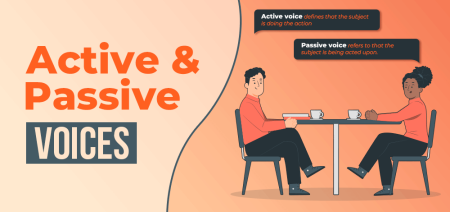
Voice refers to the grammatical feature that indicates the relationship between the action expressed by a verb and the participants in that action. In English, voice primarily manifests as either active or passive, affecting how sentences are constructed and understood.
Voice shows the relationship between the subject, verb, and object in a sentence. It allows you to decide who or what is the most important part of your story. In English, there are two types of voice: Active and Passive.
Active Voice
In the active voice, the subject of the sentence performs the action. This is the most common way to speak and write because it is direct and clear. The structure is: Subject + Verb + Object.
A sentence is in Active Voice when the subject performs the action. For examples:
- The chef cooks the pasta.
- Marta wrote a letter.
- The dog chased the ball.
In all these sentences, the subject is doing the action. Use the active voice when you want to sound strong, clear, and to show exactly who is doing the work.
Passive Voice
In the passive voice, the object of the action becomes the subject. The person or thing doing the action (the “doer”) either moves to the end of the sentence or disappears completely. The structure is: Object + "To Be" Verb + Past Participle (V3) + [by Subject].
In contrast, a sentence is in the passive voice when the subject receives the action. Passive voice shifts the focus from the doer of the action to the receiver of the action. For examples:
- Active: The teacher explains the lesson.
(Here, “the teacher” is performing the action of explaining.) - Passive: The lesson is explained by the teacher.
(Here, “the lesson” receives the action of being explained, and the doer is less important.)
Why Do We Use Passive Voice?
There are several reasons for using passive voice instead of active voice:
- When the doer of the action is unknown or unimportant
Sometimes, the person or thing performing the action is either unknown, unimportant, or implied.
Example: The road was repaired last week.
(We do not know or need to mention who repaired the road.) - When we want to emphasize the object instead of the doer
Passive voice allows us to focus on the object rather than the subject.
Example: A new policy has been introduced by the government.
(The focus is on “a new policy,” not on “the government.”) - When we want to be formal or impersonal
In formal writing or scientific contexts, passive voice is often used to maintain objectivity.
Example: The experiment was conducted in a controlled environment. (The focus is on the experiment rather than the person conducting it.)
Structure of Passive Voice
A passive verb consists of two essential parts:
- The main verb must be in V3 (past participle) form.
- There must be an auxiliary “be” verb before the main verb.
Forms of “be” in passive voice:
| Tense | Auxiliary “be” verb | Example (Active) | Example (Passive) |
| Simple Present | am/is/are | He writes a book. | A book is written by him. |
| Simple Past | was/were | She painted the wall. | The wall was painted by her. |
| Present Progressive | being | They are watching a movie. | A movie is being watched by them. |
| Past Progressive | being | She was baking a cake. | A cake was being baked by her. |
| Present Perfect | been | He has completed the project. | The project has been completed by him. |
| Past Perfect | been | They had built a house. | A house had been built by them. |
| Future | be | She will write a novel. | A novel will be written by her. |
| Modals (can, must, should, etc.) | be | You should clean the room. | The room should be cleaned. |
| Past Modals (could have, must have, etc.) | been | He must have forgotten the key. | The key must have been forgotten by him. |
Note: If the sentence already contains an auxiliary verb, the “be” verb comes after it.
- Active: She has finished the work.
- Passive: The work has been finished by her. 23 of tusw ww new
Verbs That Do Not Have Passive Forms
- Not all verbs can be used in passive voice. Generally, intransitive verbs (verbs that do not take an object) do not have a passive form. Examples of intransitive verbs: Sleep, arrive, go, die, happen, exist, etc.
Incorrect: A party was happened last night. X
Correct: A party happened last night. - Certain stative verbs (verbs that express states rather than actions) are also rarely used in passive voice, such as: Be, Have, Belong, resemble, consist of, possess, lack etc.
Incorrect: The book is belonged to me. X
Correct: The book belongs to me.
Passive Voice with Double Object Sentences
Some sentences have two objects: a direct object (the thing being given) and an indirect object (the person receiving it). In passive voice, either object can become the subject. Example:
Active: The teacher gave the students homework.
Passive 1 (emphasizing indirect object): The students were given homework by the teacher.
Passive 2 (emphasizing direct object): Homework was given to the students by the teacher.
Explanation:
In Passive 1, “students” become the subject because we want to focus on them.
In Passive 2, “homework” is the subject, shifting focus to the object instead.
The Use of “By” in Passive Voice
In passive voice, the agent (the person or thing doing the action) is often omitted when it is unknown or unimportant. However, if necessary, we use “by” to introduce the doer. Examples:
Without “by” (agent unknown or unnecessary): The cake was eaten. (Who ate it is unknown or unimportant.)
With “by” (agent specified): The cake was eaten by John. (We specify that John ate the cake.)
When to Avoid Passive Voice
Although passive voice is useful, it should not be overused. Too much passive voice can make writing less direct and harder to read. When to use active voice instead:
- When the doer of the action is important.
- When writing instructions or giving commands.
- When clarity and conciseness are needed.
Example:
Passive: A mistake was made in the report. (Unclear who made it.)
Active: The manager made a mistake in the report. (Clear and direct.)
Common Mistakes
- Active: She is eating mangoes.
Incorrect Passive: Mangoes is being eaten by her. X
Correct Passive: Mangoes are being eaten by her.
(“Mangoes” is plural, so “are” should be used instead of “is.”) - Active: She died.
Incorrect: She was died. X (“Die” is an intransitive verb and does not have a passive form.)
Correct: She died. (No passive form possible.)
Forgetting “To Be”: You cannot say “The cake eaten.” You must say “The cake is eaten” or “The cake was eaten.”
Using the wrong verb form: Always use the third form (Past Participle). It’s not “The book was write,” it is “The book was written.”
